Subscribe to the Self-Scientist Newsletter
Uniquely Bright content directly to your inbox.

Issue #026: When Does Helping Become Enabling?
I’m just getting back from three wonderful days teaching university graduate students about the social and emotional lives of bright neurodivergent kids and families.
As often happens when I teach, I came in with a lesson plan.
But some of the most interesting moments weren’t in the slides.
They came from the questions.
A Quick Family Map
One of the first things I showed the students was how I quickly sketch a family map, called a genogram, when families ask questions about their situation.
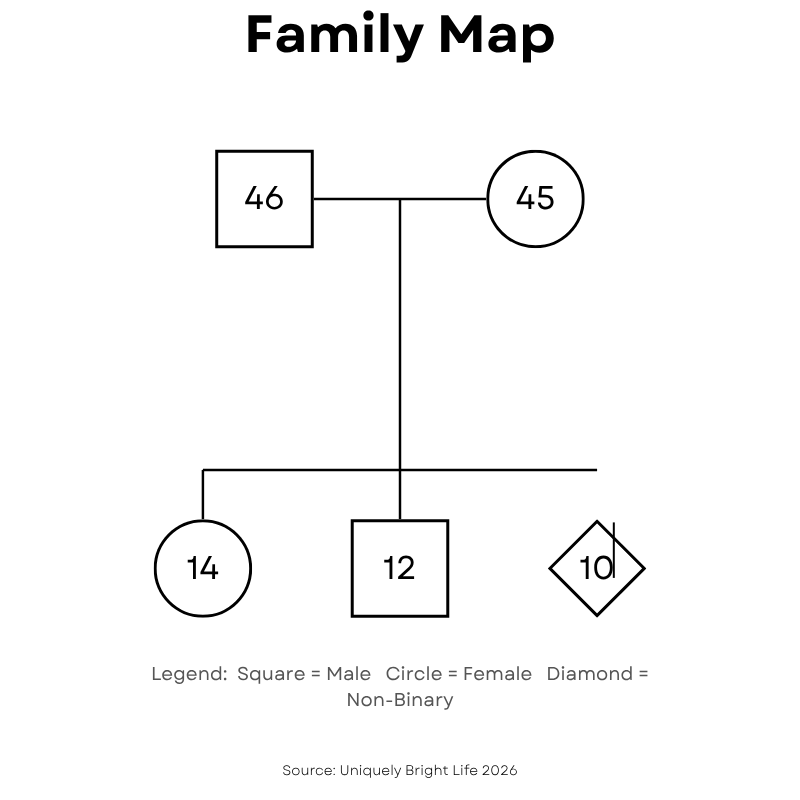
My answers are almost always age- and stage-dependent, so having a quick snapshot of the family is incredibly helpful. It helps me understand who is in the family, what strengths and challenges may be present, and how everyone is influencing one another.
Observation #1: Helping Anxiety vs Feeding Anxiety
Over the course of three days, students asked questions like:
- How do we know when a parent is supporting their child’s anxiety—or accidentally making it worse?
- When school refusal shows up, do we focus more on getting them back in class or mental health?
- Does the child need to change or does the environment need to change?
- How many demands on the child should we remove if we eventually need to bring them back?
- What if a child’s nervous system is almost always in fight, flight, or shutdown?
At first glance, these seem like very different questions.
But underneath, they all point to a similar dilemma:
How do we actually help an anxious child, instead of accidentally feeding the anxiety?
As parents, teachers, therapists, and coaches, one of our biggest challenges is finding the right balance.
When we’re too hands-off, people can flounder.
When we’re too hands-on, people can become more dependent, more anxious, or more helpless.
One distinction we discussed is the difference between enabling and empowering.

Enabling means we’re helping but robbing someone of the chance to learn it themselves.
Empowering means we’re supporting them while keeping the ownership of problem-solving in their court.
Having agency and autonomy is critical to mental health.
When we enable instead of empower, it’s usually because we love our kids and don’t want them to suffer.
But one of the challenges of parenting, teaching, and supporting bright neurodivergent kids is that the thing that reduces distress today isn’t always the thing that builds confidence tomorrow.
The art is finding the right balance.
Observation #2: Independence vs. Supported Independence
One conversation especially stuck with me.
A student shared that she does quite a bit of executive function support for her son because life is already stressful enough and she doesn’t want him carrying unnecessary pressure.
I’ve been there myself.
Many of our kids are carrying a heavy load.
Then I asked how old he was.
Seventeen, with plans to leave for college in a year.
That changed the conversation.
Because now the question wasn’t just how to reduce stress today.
The question became:
How do we help him leave home equipped?
I found myself saying something like:
“So what I’m hearing is that over the next year, we’re going to have to transfer responsibility for some of these daily life tasks and skills to him, so he can leave home equipped.”
That led to a wonderful discussion about independence versus supported independence.
Independence is:
“You’re old enough. Figure it out.”
Supported independence is:
“I’m still here to support you, but little by little, the responsibility is becoming yours.”
One of the most powerful ways to do this is through gradual release:
I do. We do. You do.
The goal isn’t dependence.
The goal isn’t throwing them into the deep end, either.
The goal is supported independence.
Observation #3: Trauma Can Hide in Plain Sight
Another question generated a lot of discussion.
One student asked:
“What if my child is almost never in the green zone? They’re almost always in fight, flight, or shutdown.”
It’s an important question.
Because many bright neurodivergent kids spend years feeling like square pegs in round holes.
Years of being on the receiving end of thousands of criticisms.
Years of feeling misunderstood.
Years of trying harder and still feeling like they can’t quite get it right.
I replied:
“I don’t know your child, but when someone is spending most of their life in fight, flight, or shutdown, I start wondering whether there may be some unprocessed trauma onboard.”
Her response came immediately:
100% trauma.
That exchange stayed with me.
We then talked about some of the gold-standard treatments for trauma and why understanding the nervous system is so important when supporting bright neurodivergent kids.
More on that another day.
Because sometimes what looks like anxiety, avoidance, defiance, emotional reactivity, or school refusal is actually a hypervigilant nervous system sensing threat.

In Polyvagal Theory, this process is called neuroception—the nervous system’s constant scanning for danger and safety.
A Question For You
These were just a few of the conversations we had over three rich days together.
We talked about anxiety, trauma, nervous systems, executive function, school refusal, self-esteem, friendship, and much more.
But I keep coming back to that central question:
How do we support bright neurodivergent kids in ways that help them grow rather than become more dependent, more anxious, or more helpless?
It’s a question worth wrestling with.
In fact, I’m thinking about putting together a day-long workshop on the social and emotional lives of bright neurodivergent kids and families.
We could explore topics like:
- Anxiety and emotional regulation
- Trauma and the nervous system
- School refusal
- Executive function and independence
- Self-esteem and identity
- Friendship and social connection
- The neurodivergent marriage
- And much more
It would be designed for parents, educators, therapists, coaches, and anyone who supports uniquely bright kids.
If that sounds interesting, hit reply and let me know.
Also let me know about format…
Would you prefer something online?
Or would you enjoy gathering together in person somewhere near the water here in the Seattle area?
I hear from so many people in our community that they’re craving more IRL (in real life) connection.
The convenience of online learning is wonderful.
But there is also something special about spending a day together with people who care deeply about helping bright neurodivergent kids thrive.
I’d love to hear what sounds most appealing to you.
Subscribe to the Newsletter
Want more Uniquely Bright content?
Get the newsletter delivered to your inbox every week.