Subscribe to the Self-Scientist Newsletter
Psychological insights to help you feel, think and live better.

Issue #035: Ready to Change (or Not)?

Ever know what you should absolutely do and not actually do it?
Yeah, me too.
Take exercise for example.
The scientific evidence for the short- and long-term health benefits of exercise is overwhelming.
Yet we often feel too tired, the weather is too inclement, we’re too busy with other things, or we haven’t done the groundwork to connect with a way to move our bodies that is fun and enjoyable.
But there’s another reason we get stuck. Understanding it may help you make progress on your important goals, and help nudge the progress of those you love.
The Stages of Change
It’s called the Stages of Change, developed by psychologists James Prochaska and Carlo DiClemente, and explained in their book Changing for Good.
Here are the five stages and how to orient to each:
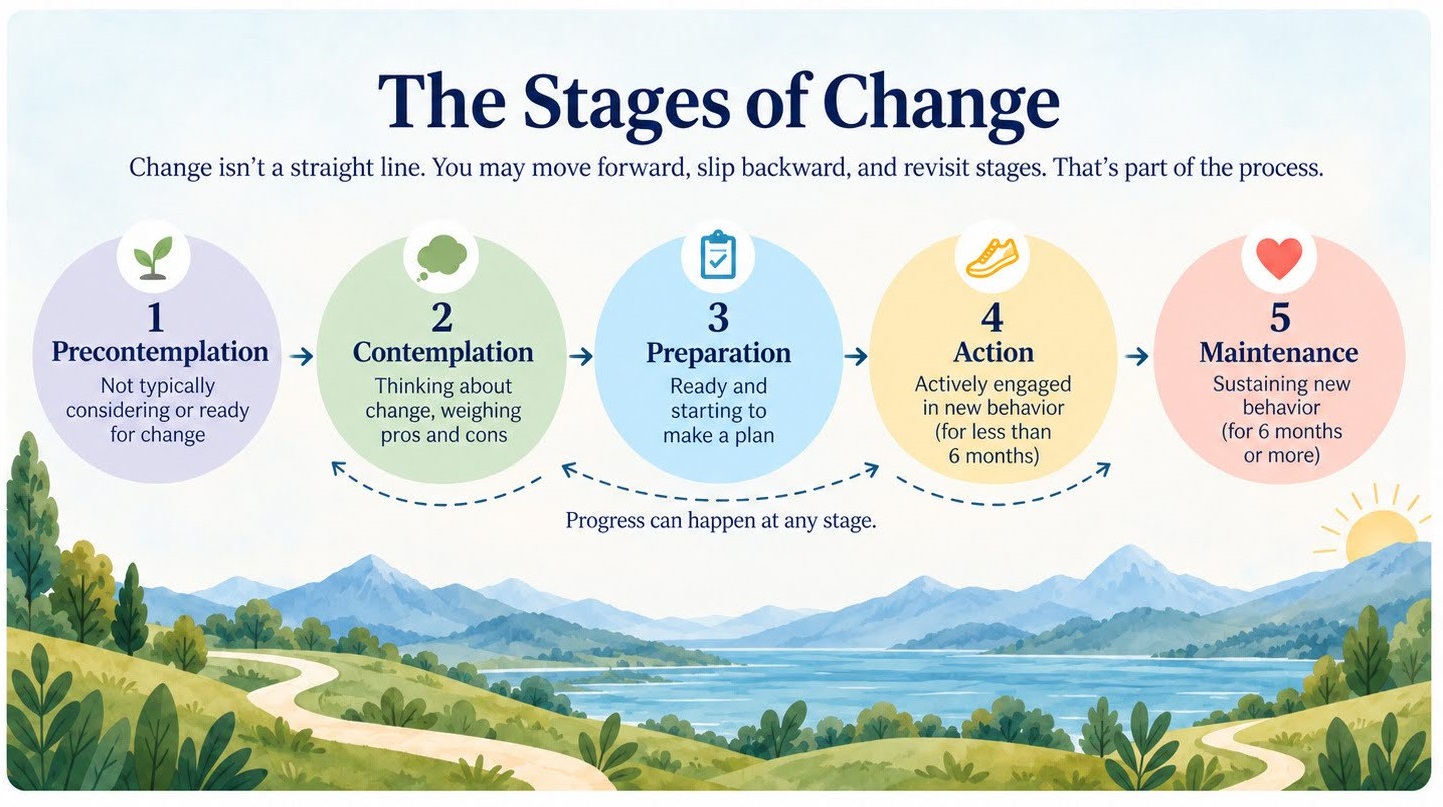
Source: Uniquely Bright Life, 2026
Stage 1: Precontemplation
Precontemplators are not typically considering or ready for change. They may be unaware or in denial about the need for change.
The focus for these folks is to gently raise awareness and curiosity about why change might be a good idea. Perhaps certain behaviors are leading to mental, physical, social, or emotional struggles.
For precontemplators, we might ask permission to share articles, stories, or videos that help them see the issue in a new light, rather than pushing them to take immediate action.
One of my favorite therapy questions that unlocks a little door is, “If I told you I have another client struggling with [insert the issue], what would you advise them to do?”
A small step: Get curious rather than judgmental. Ask, “How might this behavior be affecting my life or the people I care about?” Sometimes a little curiosity is all it takes to open the door to change.
Stage 2: Contemplation
Contemplators may be thinking about change or have mixed feelings about change, weighing pros and cons. People can contemplate for months and years.
This is where the “miracle question,” one of my favorite therapist tools, can be helpful: “If you could wave a magic wand and wake up tomorrow with this problem solved, what would you be seeing more or less of in your life?”
Bringing a vision of an outcome into focus helps concretize a point B to travel to.
Taking assessments, like an anxiety, depression, or quality-of-life scale, can also be helpful.
A small step: Ask yourself, “What would I gain by making this change?” and “What would I lose or have to give up?” Being honest with yourself about both sides can help you gain clarity about what you really want.
Stage 3: Preparation
Preparers acknowledge their need for change and they want to change. They’ve navigated the tricky contemplation stage and decided to move forward. They start taking small steps toward change.
This is where quick wins, baby steps, aka 1% wins, can be very helpful.
For example, if you decide you want to pursue exercise indoors for the winter, you might take some baby preparation steps:
- Google opportunities in your area, e.g., a gym, a community center class, or a weightlifting group.
- Put a few scheduled activities on your calendar.
A small step: Try making an “if-then” plan. For example, “If it’s Tuesday at 9 a.m., then I’ll go to my strength training class.” Research suggests that deciding exactly when and where you’ll take action can make it much more likely that you’ll follow through.
Stage 4: Action
The action taker is actively engaged in a new healthy behavior and has been doing so for less than six months.
To keep new actions going so they become habits, we can encourage action takers to communicate their goals and actions to friends and family, and identify supportive relationships and accountability buddies.
Participating in structured, scheduled group activities can be a huge support to ongoing action.
A small step: Set yourself up for success by making the healthy choice the easy choice. Put your walking shoes by the door, lay out your exercise clothes the night before, or arrange to meet a friend at a class. The fewer obstacles in your way, the easier it is to follow through.
Stage 5: Maintenance
The maintainer has been sustaining the new healthy behavior for six months or more. They’re working to make these actions stick as part of their routine.
Forging friendships with people who take similar actions can be life- and identity-changing.
Instead of thinking of yourself simply as someone who does a particular activity, you might begin to see yourself as a healthy person, a good friend, or someone who takes good care of themselves.
To strengthen this identity shift, ask yourself, “What would a [insert identity, e.g., healthy person, good friend] do right now?”
Would they take the stairs instead of the elevator? Would they fill their water bottle in the morning? Would they give a friend the benefit of the doubt?
You get to decide based on the identity you’re striving for.
A small step: Think ahead about what might knock you off track. What will you do when you’re traveling, tired, sick, or overwhelmed? Having a backup plan can help you stay connected to the person you’re becoming, even when life gets in the way.
And remember, change isn’t always linear. You may move forward, slip backward, and start again. That’s part of the process, not a sign of failure.
The Importance of Matching Stage and Strategy
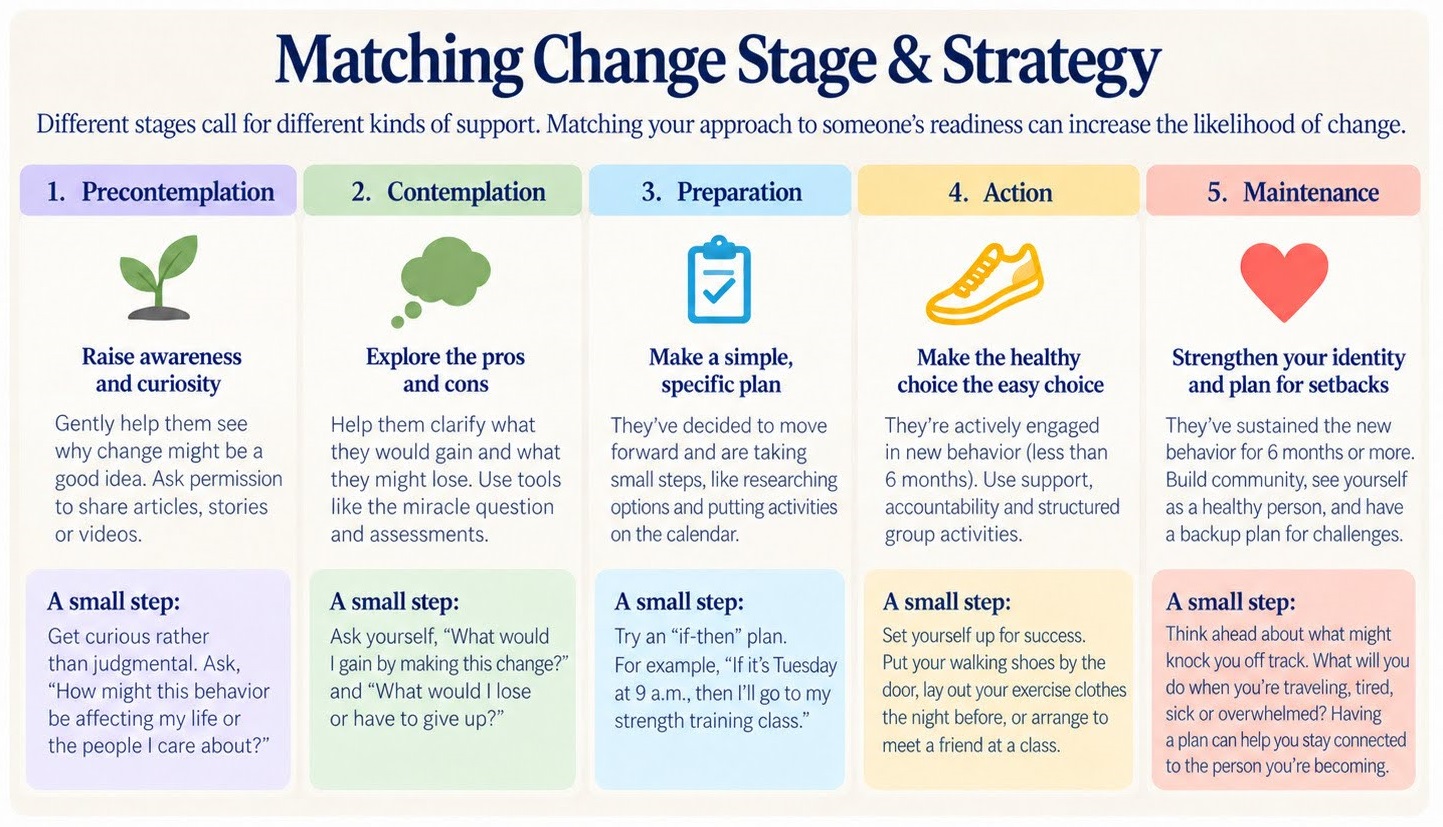
Source: Uniquely Bright Life, 2026
Viewing the likelihood of change through this readiness-stage lens helps us find good-fit strategies for change.
You can’t solve a contemplation problem with an action strategy.
If you expect a precontemplator to rush into action, you’re holding the bar in the wrong place and will surely be disappointed.
If you ask a preparer to try a 1% experiment, e.g., Googling a local movement class, the likelihood of that happening is much greater.
Matching our approach to someone’s readiness can increase the likelihood of change, rather than creating frustration for everyone involved.
What’s Bubbling Up for You?
I’m curious to know what you’re reflecting on as a result of this newsletter issue.
- What kind of change has been on your mind that you’re not yet taking action on?
- What stage of change readiness would you say you’re in?
- What’s a tiny 1% action that could give you more clarity or help you move forward?
Hit reply and let me know.
This is a no-shame, no-blame community. Acknowledging where you are, with compassion rather than judgment, is a great place to begin.
Subscribe to the Newsletter
Get fresh psychological insights from a licensed therapist to help you feel, think and live better—delivered straight to your inbox.
Subscribe to the Newsletter
Get fresh psychological insights from a licensed therapist to help you feel, think and live better—delivered straight to your inbox.